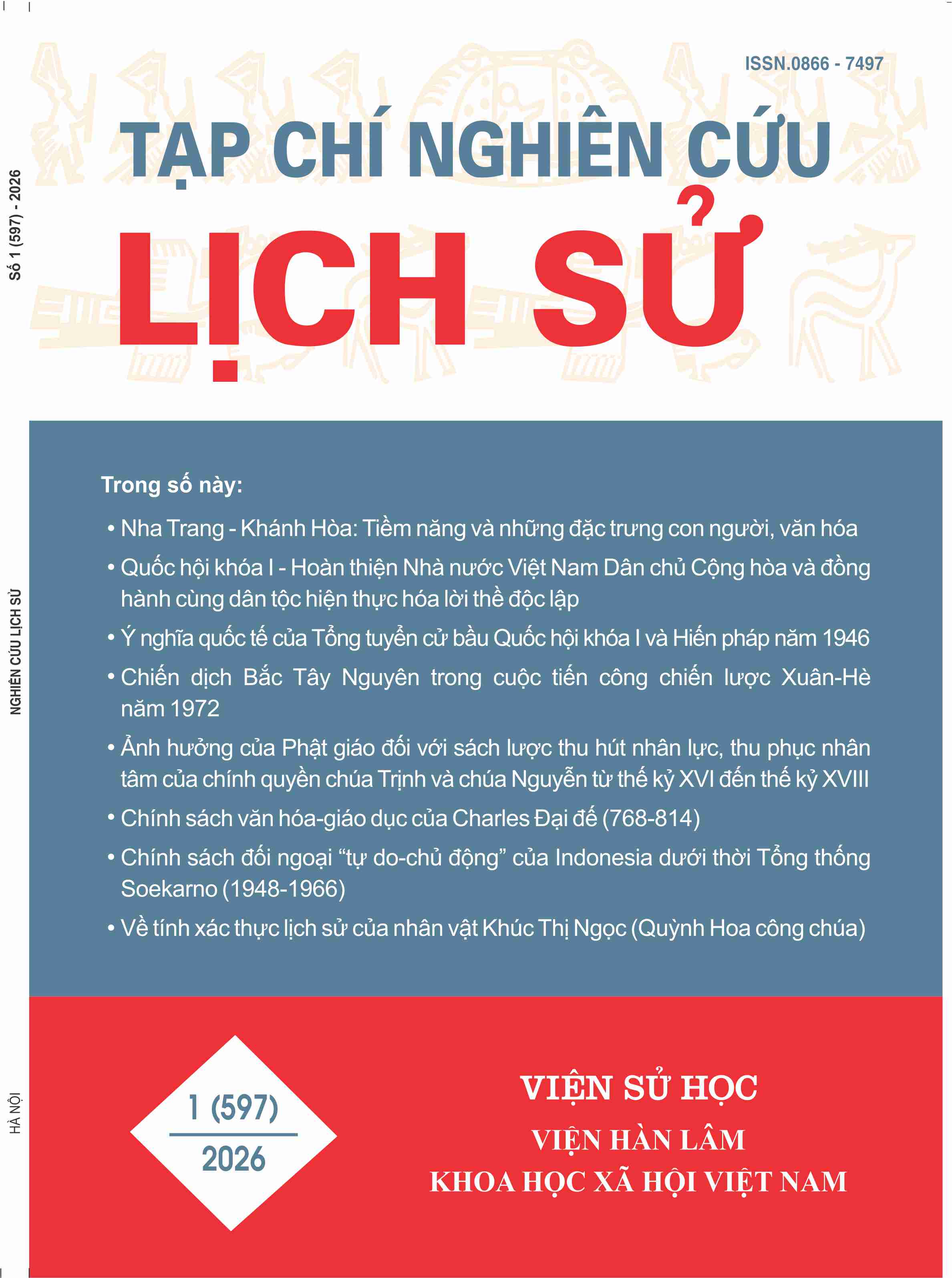
The Influence of Buddhism on the Strategies of Attracting Human Resources and Winning Popular Support under the Trịnh Lords and the Nguyễn Lords from the Sixteenth to the Eighteenth Centuries
Keywords:
Social stabilization, Nguyễn lords, Trịnh lords, Buddhism, ideology.Abstract
In the course of Vietnamese history, the Lê Restoration period (Lê trung hưng) represents a phase marked by complex and dynamic transformations in political, economic, cultural, and social spheres. Although during this period Buddhism no longer retained its status as the state religion as it had under the Lý and Trần dynasties, it nevertheless exerted a certain degree of influence on the political landscape, particularly in shaping the strategies of attracting human resources and securing popular support employed by the Trịnh and Nguyễn regimes from the sixteenth to the eighteenth centuries. Employing historical methodology, logical analysis, and comparative approaches, this article examines in depth the impact of Buddhism on policies aimed at social stabilization, recruitment of human resources, and consolidation of popular allegiance under the Trịnh-Nguyễn administrations. From this analysis, it can be observed that throughout the longue durée of Vietnamese history, the spirit of Buddhism has consistently intertwined and harmonized with the broader ethos of the nation.