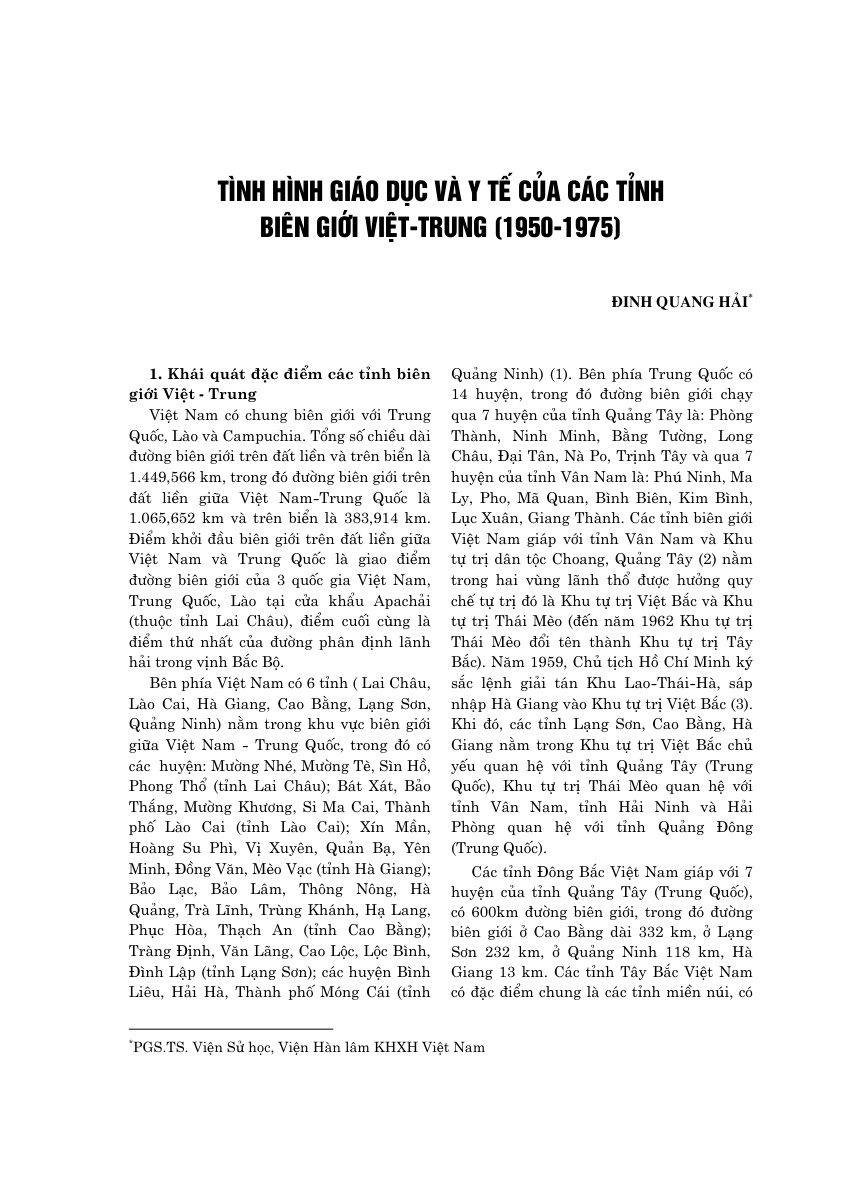
Education and health care situation in Vietnam’s border provinces neighboring China (1950-1975)
Authors
PGS.TS. Đinh Quang Hải
Author
Keywords:
Education, healthcare, border, Vietnam - China.
Abstract
Vietnam shares borders with China, Laos and Cambodia, in which the Sino-Vietnamese land border extends 1,065.652 km. On the Vietnamese side, there are 6 provinces located along the Vietnam-China border area, namely Lai Chau, Lao Cai, Ha Giang, Cao Bang, Lang Son, and Quang Ninh; while on the Chinese side, there are 14 districts, including 7 of Guangxi province and 7 of Yunnan province. Because of the geographical location, topography, and natural conditions of Vietnam’s six northern border provinces which are mostly rocky mountainous, difficult transportation, poor infrastructure, and the majority of the population are ethnic minorities with low educational level, there are many difficulties to promote socio-economic development in the region. During the period of 1950-1975, with Communist Party of Vietnam’s attentions, the State and local Party committees determined to overcome all ethnic minorities’ difficulties and promote education and health care. The result came with many important achievements and dramatic changes in the people’s cultural development, livelihood improvement and new progress in medical work and health care for the people. This article aims to clarify the nature of education and health care in the northern border provinces and their transformation between 1950 – when Vietnam and China set up diplomatic relation and 1975 – when Vietnam completed the liberation of the South and reunification of the country. Thus, it affirms the extremely correct and creative socio-economic development policies and guidelines of the Communist Party of Vietnam in the context of building socialism in the North and fighting against the US imperialists and the puppet Saigon government to completely liberate the South to reunify the country.